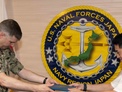

In November 2008, the commander of Naval Region Japan, Rear Admiral James D. Kelly, gave the service’s official hamburger recipe to Yokosuka Mayor Ryoichi Kabaya as a symbol of friendship between the U.S. Navy and City of Yokosuka. Kabaya later announced the recipe would be the foundation of the now trademarked Yokosuka Navy Burger and shared it with participating restaurants. Each restaurant then shared their variation to an unimaginable number of Japanese TV shows, photographers, tourists, local residents and Shore Patrol for the last 15 years.This is all well-known.A simple Google search of “Yokosuka Navy Burger” would return a few dozen pages of news stories, blog posts and marketing pieces all seemingly paraphrasing the same 150 or so words. It’s so heavily repeated even ChatGPT struggles to generate a different response no matter how many times it’s asked to write in the style of various publications.Even the last part of this two-part series states the origins of the Yokosuka Navy Burger in 2008. And it’s true in the absolute, most definite terms. The Yokosuka Navy Burger is a trademark that is easily traced to 2008.But it would seem Yokosuka’s hamburger story would be older than David Tyree’s “Helmet Catch.”15 years ago, Danica Patrick was the first woman to win an INDYCAR race, The Dark Knight topped the box office, and Little Big Planet was being touted as the “most important video game of this generation.” On the other hand, Yokosuka City has been well documented over several decades for it’s American-influenced style.
One of the most famous photographs from Miyako Ishiuchi’s 1977 “Yokosuka Story” features the back of a rebellious, young Japanese man in a jean jacket with an embroidered USS Rathburne skull and crossbones paired with Navy dungarees. The Sukajan, a cute word-play of Yokosuka and jacket, gained fame with Sailors here in the late-40s and became a local cultural fixture by the 60s. There are numerous bars within walking distance of the naval base’s main gate each boasting some of Japan’s earliest recorded punk rock and metal history. The establishments are easy to spot; just look for sticker graffiti overlapping each other over every square inch of the properties’ exteriors.
So it seems strange that a city with a rich past of blue jeans and rock n’ roll would have just forgotten the pinnacle of American imagery; the hamburger.
The story of the Yokosuka Navy Burger is a local icon that goes farther back than 2008. Much farther.
In 1983, Yokosuka’s own Nile C. Kinnick High School graduate Mark Hamill headlined “Return of the Jedi,” an event that everyone at the time thought would forever close the book on the Star Wars saga. It was also the year that Yokosuka’s own Club Alliance would reopen their doors to the base community and general public in a new location.
On May 27, 1983 over the long Memorial Day weekend, a ribbon-cutting welcomed the new Club Alliance. The ceremony concluded a three-year-long construction project that moved the club to the installation’s Carney Gate. What was once neighboring Shioiri Station was now directly adjacent to the quarterdeck.
When the old Club Alliance closed in preparation for demolition in 1980, The Windjammer had actually taken over the role as the place to be to get a burger.
The Windjammer, now the CPO Club, offered everything the old Club Alliance served and then some. A Sailor could walk in and get a burger for as little as $0.89.
But 1983 is still far too recent.
40 years before Rear Admiral Kelly gave his letter to Mayor Kabaya and nearly a half decade before the admiral had even started his Naval career, MLB had a major problem on their hands as 1968’s Year of the Pitcher plummeted batting averages across the league to a paltry .235, NBC cut off the final 65 seconds of a 32-29 game between the New York Jets and Oakland Raiders to ensure a rerun of “Heidi” started on time, and the Apollo 8 mission made the first manned orbit of the moon.
It was also in 1968 that one of the 15 restaurants now authorized to carry the official Yokosuka Navy Burger trademark was founded.
Haruki Naoi, a former galley employee at what would become the modern-day Commodore Matthew C. Perry General Mess, opened a restaurant across the street from Fleet Activities Yokosuka in 1968. Naoi’s establishment joined several others in the areas, but his is the only one still in business today.
His idea was to sell “… genuine hamburgers …” with “… authentic American flavors.”
The restaurant, at the time famous as a break area for military police and shore patrol, served American diner classics. It’s proximity to the base paired with the Sailors’ ability to tip generously thanks to a 360 Japanese yen-to-one U.S. dollar exchange rate made the spot popular for both locals and military.
Though it’s possible that Naoi’s diner was the first commercial establishment in Yokosuka slinging beef patties on toasted buns, 1968 is still too recent for this port city.
Many Yokosuka Sailors spent a good amount of their liberty at the Enlisted Man’s Club – even in 1968 – a full 17 years after base leadership authorized Sailors to visit almost any restaurant in the city.
The EM Club, as it was more commonly referred to, predates Club Alliance. The club actually changed its name from the EM Club to Club Alliance. The EM Club was such a fixture to Yokosuka’s history, that it even predates Morale, Welfare, and Recreation, or MWR, as it’s known today. The military-operated, local employee-staffed club was located where Mercure Yokosuka stands today, and pumping out big band jazz tunes. It was a place where Sailors of all ranks could enjoy their time off and dance for hours to local, live music, unwind with their family over a perfectly cooked steak dinner, or catch up with the latest shipment of library books. Like Club Alliance, it was a multiple story building with different establishments inside offering Sailors a choice of what type of environment they prefer.
One of those establishments was The Snack Bar. They advertised “grilled beef burgers” to Sailors in undress blues as early as January 1952 in the Seahawk, the base’s weekly newspaper before taking on its more common name, Seahawk-Umitaka.
Prior to this issue, though, The Snack Bar never mentioned hamburgers. Strangely, the word disappears and reappears in the same reprinted notice throughout the 1952 Seahawk catalog. Was the EM Club serving burgers in 1951? Or was it as simple as a bored editor occasionally swapping out one slightly differently worded advert for another? Maybe the club’s other smash hit, Jazz Night, took Sailors, their dates and The Snack Bar staff away from the grill.
This inconsistent ad run marks the beginning of where this burger story starts to get unclear and creates another question with each one answered.
On May 26, 1951, the staff of the Seahawk wrote the unimaginative, but very correct headline “Japanese Eating, Drinking Establishments In Yokosuka City That May Be Patronized” and listed seven bars and restaurants servicemen may now visit. The list included: Komatsu, Uokatsu, Sumiyoshi, Daikokaya, The Golden Pheasant, Sakura Beer Hall, and Yokosuka Beer Hall. Of those seven, Daikokaya and The Golden Pheasant are listed as having American menus. Were they serving hamburgers?
Less than three months later, on August 11, 1951, baseball fans in New York saw the first color television broadcast of the visiting Boston Braves putting an 8-1 hurt on the hometown Brooklyn Dodgers, and servicemembers in Yokosuka were told all off-base restaurants displaying a Japanese National Food Sanitation Code Grade ‘A’ placard were now authorized to visit thus opening up their liberty. Interestingly, a minor note was also added in a later issue stating that ground meats may be purchased from butchers displaying the local health inspector’s grade ‘A’ signage.
Does this mean that the EM Club couldn’t have made hamburgers before August 11, 1951 because they couldn’t source ground meat?
According to Naoi’s restaurant, that’s not the case at all.
The EM Club brags about serving local steaks in every single issue of the Seahawk’s 1951 volume. Though it’s unclear if the club staff could acquire ground meat at the time, they certainly could purchase various cuts of beef from local butchers.
Which takes us back to Rear Admiral Kelly giving Mayor Kabaya a hamburger recipe.
In 1945, the United States Government Printing Office published “The Cook Book of the United States Navy,” a 456-page dry read. Beef Cheeseburgers are on page 138. The recipe calls for 45-pounds of bone-in beef that is then cut into small pieces and ground by the cook with salt and pepper.
Irrelevant, but there is one part of the recipe that stands out; “… Cover lower halves [of buns] with slice of cheese. Place lower half under broiler until cheese is melted. Cover cheese with hot meat pattie [sic].” The Navy settled the debate by direction before a debate could be started. From top-to-bottom: bun, patty, cheese, bun.
The recipe, designed for 200 servings, reads:
• 35-pounds bone-in beef
• ¾ cup of salt
• ½ cup of pepper
• 200 buns, round
• 10-pounds Cheese, American, cheddar, sliced
• 4 cups of mayonnaise
• 2 cups of Pickle relish
The book also instructs Navy cooks how to debone and grind butchered meat. And also provides recipes for each of mayonnaise and pickle relish.
A much simpler recipe. Just salt and pepper. A call back to the Armed Forces Recipe Service recipe database used by the Commodore Matthew C. Perry General Mess. The service that intended to reign in in-house recipes like the CFAY Western Burger. That had evolved from generations of mess cooks off the original Navy cook book and influenced dozens of burger joints immediately beyond the gate.
The Yokosuka Navy Burger may have been officially named in 2008, but it’s story is just as old as any other piece of America here.